
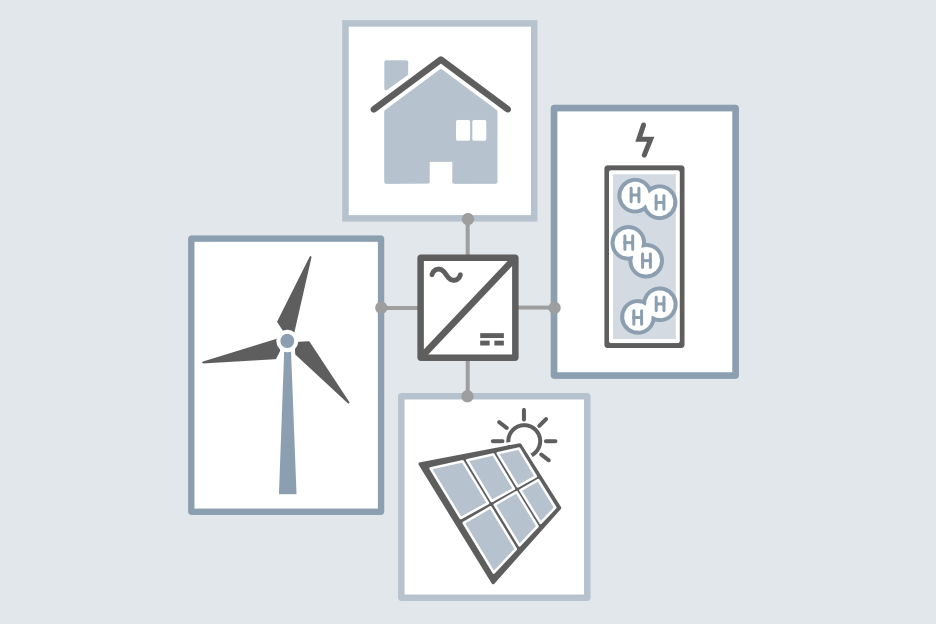
The energy-efficient operation of technical systems is of increasing importance in view of global warming and the transition to renewable energies. Control systems engineering has a high potential to contribute to the efficient use of energy, for example, regarding energy consumption of buildings, energy conversion and storage, as well as power grids. Our research in terms of optimization and learning-based control methods forms the ideal basis to develop sustainable solutions in energy-related applications.
The efficient and sustainable use of energy is one of the grand challenges today. Control engineering is a key technology to accomplish this goal by providing tailored automation solutions. For instance, heating, ventilation and air conditioning (HVAC) systems in residential and non-residential buildings belong to the largest energy consumers. Advanced control schemes can help to efficiently control HVAC systems while learning the building characteristics like thermal dynamics or room occupancy patterns and considering stochastic weather forecasts to reduce the energy consumption in a predictive manner.
Another example are electrical grids that connect energy sources (power plants, wind turbines, etc.) and energy sinks (e.g. factories, households). On the lower level, each involved component, e.g. drives and inverters, can be designed to reduce undesired power dissipation. On the higher level, the energy distribution itself can be optimized using, for instance, distributed model predictive control for smart grids.
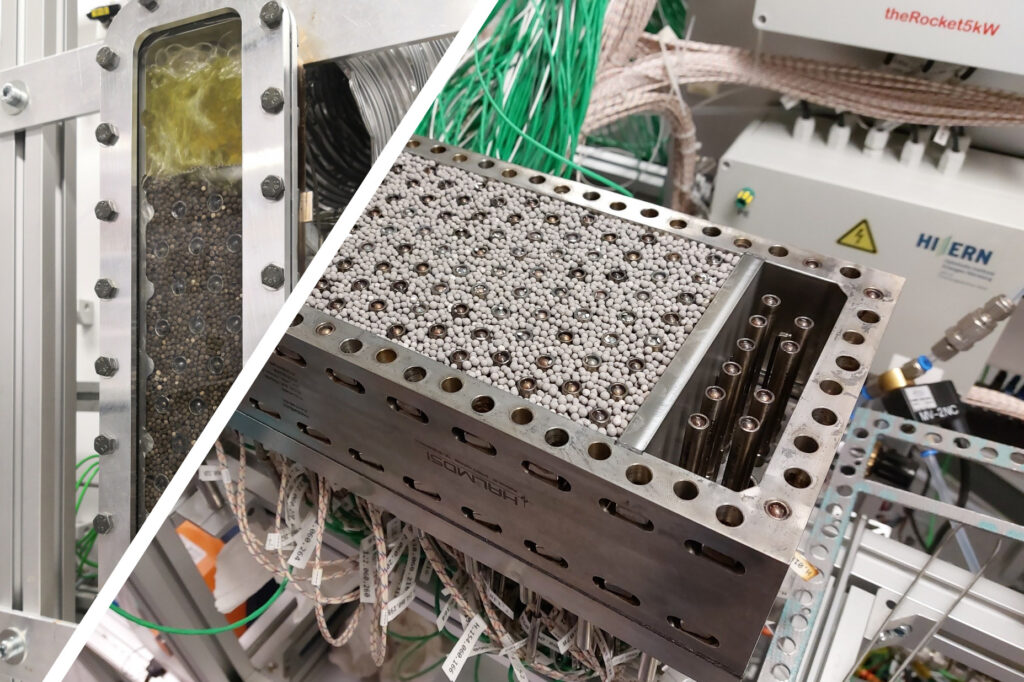
Despite the current prevalence of batteries as mobile energy storages, hydrogen-based fuel cells are a promising alternative for applications with high energy demand as, for example, trains or ships. One option to solve the problem of save hydrogen storage is the use of liquid organic hydrogen carriers (LOHC), either as storage/transport medium or for direct fuel cell usage. The de-/hydrogenation of LOHC is a complex process that offers high potential for improvement by modern control methods.

Related projects since 2021
Funding source: Industrie
Project leader:

Prof. Dr.-Ing. Knut Graichen
Chair holder
Funding source: Bundesministerium für Wirtschaft und Energie (BMWE)
Acronym: AGENT-2
Project leader:
Prof. Dr.-Ing. Knut Graichen
Chair holder
To achieve climate targets, CO2 emissions in the building sector have to be significantly reduced. However, the integration of renewable energy sources increases the complexity of building energy systems and thus the requirements for the operation strategy. Model-based and predictive controllers are necessary for efficient operation. However, due to the high complexity of the energy systems, the development, implementation, and commissioning are very complex leading to high costs, which is why m…
Funding source: Industrie
Project leader:
Prof. Dr.-Ing. Knut Graichen
Chair holder
Funding source: Helmholtz-Gemeinschaft
Acronym: H2Season
Project leader: , ,
Prof. Dr.-Ing. Knut Graichen
Chair holder
Funding source: Bundesministerium für Wirtschaft und Energie (BMWE)
Acronym: SAGE
Project leader: ,
Prof. Dr.-Ing. Knut Graichen
Chair holder

The SAGE research project aims to significantly improve the efficiency and sustainability of buildingautomation through the systematic use of Large Language Models. The existing German building stockharbors considerable savings potential that has so far remained untapped due to outdated automationsystems and inadequate data structures. A central obstacle in this regard is the so-called "onboardingproblem": building documentation in existing structures typically exists in heterogeneous formats an…
Related publications since 2020
- , , :
Slow Converter-Driven Stability Analysis via Directional and Relative Passivity Indices
23rd IFAC World Congress (Busan (Korea), 23. August 2026 - 28. August 2026)
- , , , , :
Passivity-Based Robust Stability Analysis of the Converter–Grid Interaction and Passivity-Shaping Controller Design
In: IET Generation Transmission & Distribution 19 (2025), Article No.: e70090
ISSN: 1751-8687
DOI: 10.1049/gtd2.70090 - , , :
Stochastic model predictive control with switched latent force models
In: European Journal of Control 85 (2025), p. 101311
ISSN: 0947-3580
DOI: 10.1016/j.ejcon.2025.101366 - , :
Physics-informed sparse Gaussian processes for model predictive control in building energy systems
11th Vienna International Conference on Mathematical Modelling (MATHMOD 25) (Vienna (Austria), 19. February 2025 - 21. February 2025)
In: IFAC-PapersOnLine 2025
DOI: 10.1016/j.ifacol.2025.03.009
URL: https://www.sciencedirect.com/science/article/pii/S2405896325002265 - , , :
Application of stochastic model predictive control for building energy systems using latent force models
In: At-Automatisierungstechnik 73 (2025), p. 441-450
ISSN: 0178-2312
DOI: 10.1515/auto-2024-0160
URL: https://www.degruyterbrill.com/document/doi/10.1515/auto-2024-0160/html
- , , , , , :
Bayesian optimization of operating points of a continuous perhydro-dibenzyltoluene dehydrogenation reactor
In: International Journal of Energy Research (2024), Article No.: 5627453
ISSN: 0363-907X
DOI: 10.1155/2024/5627453 - , , :
Occupancy Prediction for Building Energy Systems with Latent Force Models
In: Energy and Buildings (2024), p. 113968
ISSN: 0378-7788
DOI: 10.1016/j.enbuild.2024.113968
- , , :
Online learning and adaptation of nonlinear thermal networks for power inverters
49th Annual Conference of the IEEE Industrial Electronics Society (IECON 2023) (Marina Bay Sands (Singapore), 16. October 2023 - 19. October 2023) - , , :
Improved nonlinear estimation in thermal networks using machine learning
IEEE International Conference on Mechatronics (ICM 2023) (Loughborough (UK), 15. March 2023 - 17. March 2023)
In: Proc. IEEE International Conference on Mechatronics (ICM 2023, accepted) 2023
DOI: 10.1109/icm54990.2023.10102071
- , , :
Comparison of sensitivity-based and ADMM-based DMPC applied to building automation
6th IEEE Conference on Control Technology and Applications (CCTA) (Trieste (Italy), 22. August 2022 - 25. August 2022)
DOI: 10.1109/ccta49430.2022.9966164 - , , , , :
Circulating current control and energy balancing of a modular multilevel converter using model predictive control for HVDC applications
48th Annual Conference of the IEEE Industrial Electronics Society (IECON 2022) (Brussels (BE), 17. October 2022 - 20. October 2022)
DOI: 10.1109/iecon49645.2022.9968973 - , , :
Dynamic and stationary state estimation of fluid cooled three-phase inverters
26th IEEE International Symposium on Power Electronics, Electrical Drives Automation and Motion (SPEEDAM 2022) (Sorrento (Italy), 22. June 2022 - 24. June 2022)
DOI: 10.1109/speedam53979.2022.9842247
- , :
A sensitivity-based distributed model predictive control algorithm for nonlinear continuous-time systems
In: 5th IEEE Conference on Control Technology and Applications (CCTA) 2021
DOI: 10.1109/ccta48906.2021.9658733